
Build a practical AI roadmap by identifying business use cases, prioritizing opportunities, assessing readiness, and planning enterprise AI implementation.
A parts distributor with nine branches takes three days to return a typical quote. Customers grumble. A competitor answers within the hour. So the sales director asks for an AI quote assistant, and the board approves it in one meeting.
Six months later, the assistant works well, yet quotes still take almost three days. Nobody had measured where those days went, so the plan aimed at the wrong step. Finding the right step is early work for AI strategy consulting. It happens before any vendor demo.
The distributor is invented, though the story will sound familiar. This piece follows it from a first measurement to a company-wide rollout. Along the way, it borrows public cases from McDonald’s and Taco Bell. Survey data from S&P Global and Gartner fills in the wider picture. And there’s a cost table, since rollout bills tend to surprise people more than model quality does.
Most of it comes down to measuring early and naming owners. Why do teams skip both? Mostly because a pilot looks fine without them. A sound artificial intelligence strategy has to survive the months after the pilot ends.
A Three-Day Delay and the Wrong Fix
Sales had a theory about the delay, so the team timed 200 quotes from the previous quarter.
Where the Three Days Went
Each clock ran from the customer’s request to the moment the quote went out. Averages were then split by step, and they surprised nearly everyone.
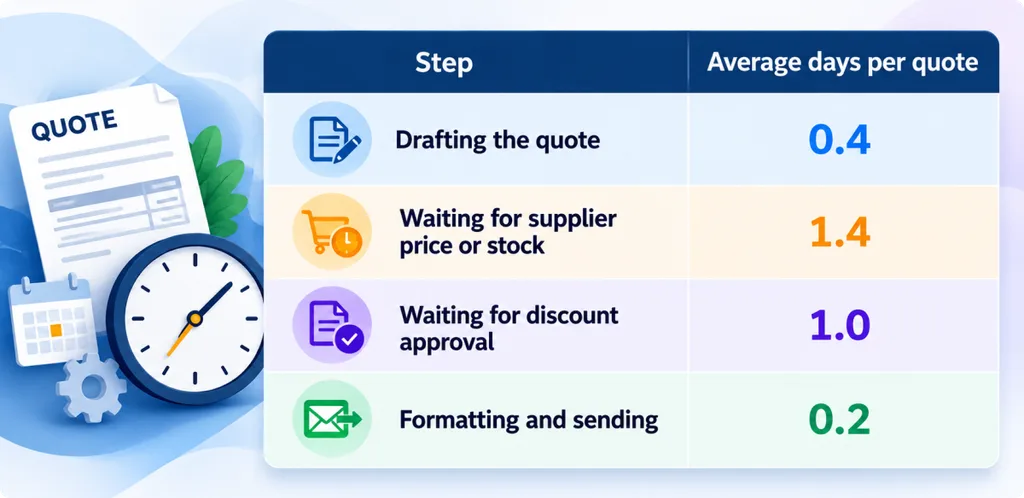
Drafting, the step an assistant would speed up, made up about an eighth of the delay. Almost everything else was waiting. That’s awkward to automate, since the waiting belongs to suppliers and managers.
A junior analyst spent two weeks on the study. In hindsight, it was the cheapest AI strategy consulting the company ever got.
The Obvious Tool Touched the Smallest Slice
An assistant that drafts quotes in ten seconds looks impressive in a demo. On the study’s numbers, though, it would save about 0.3 days out of 3.0. So what would it actually have fixed? Very little, and customers would barely notice.
Still, the board wasn’t being foolish. Sales had made the request, the demo was polished, and the price was low. What went wrong was the order of events. The company picked the use case before it located the delay. So the roadmap started from a tool and worked backward.
What the Study Changed
Afterward, the shortlist looked different. Supplier price and stock lookups held 1.4 days, and discount approvals another 1.0. Neither would make a good demo. Both did have owners who felt the pain daily.
Three suppliers, it turned out, caused most of the supplier delay. They emailed price lists as PDFs. Everyone knew that informally. Nobody had counted it, so it never reached a roadmap. Next, the company paid for two weeks of AI business consulting, mostly to interview buyers and branch managers. Nobody had asked them before.
Ranking the Candidates
Four candidates came out of the interviews, and a spreadsheet with four columns was enough to rank them.
Four Candidates, Four Columns
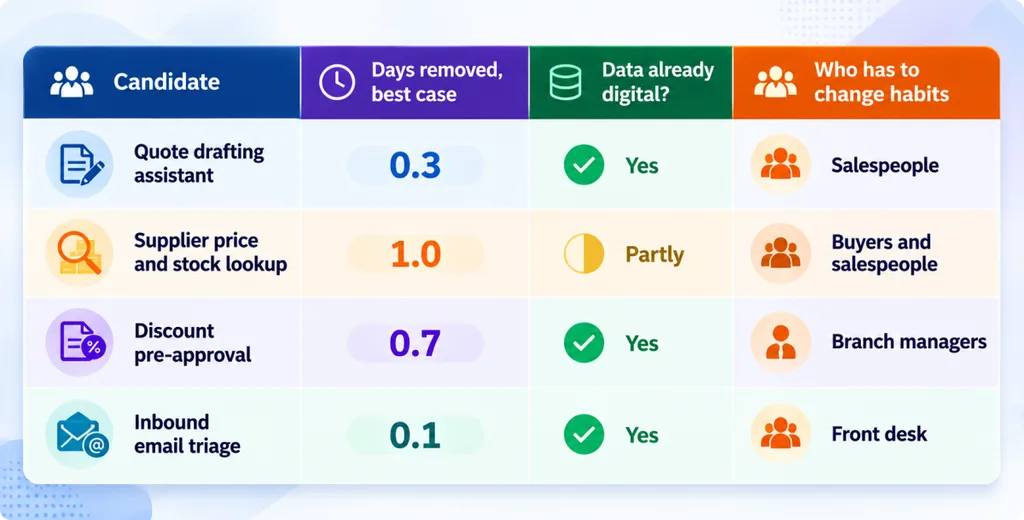
That last column nearly got cut. Which would you have checked first? Probably the biggest number. But discount pre-approval shows why that’s risky. Managers signed off on every discount above 5%, and the proposal let software approve up to 8% automatically.
That takes sign-off power from people who’ve held it for years. Fights like that can stall a pilot for months. So any decent AI use case prioritization has to price resistance, since a tool nobody adopts removes zero days.
Why the Dull Option Keeps Winning
An MIT report covered by Fortune in August 2025 found something similar at a larger scale. Its strongest returns came from back-office automation. Yet more than half of the generative AI budgets in the study went to sales and marketing tools. One guess is that those tools demo well and lookup tools don’t. Since the report relied on interviews and surveys, its percentages deserve some caution.
Turning the Ranking Into a Sequence
Supplier lookup went first, mainly because it was the biggest slice. Those three PDF suppliers needed a one-time data cleanup, and that cleanup helped everything after it. Discount pre-approval came second, once lookup was stable. Last came the drafting assistant, the board’s original idea. It needed accurate supplier prices to draft well, so it gained from waiting.
That order became the first draft of the company’s AI roadmap. Each line got an owner and a start date.
Why Pilots Flatter the Idea
Pilots carry a built-in bias, because somebody picks the cases and somebody watches the results.
● A 100-Restaurant Test That Ended Anyway
In June 2024, McDonald’s said it would end its voice ordering test with IBM. It had run since October 2021 in about 100 restaurants. McDonald’s still called voice ordering part of its future, and it planned to pick a solution by year-end. So the idea survived while one setup didn’t.
A roadmap with no row for “test ends, idea continues” leaves that second decision to improvisation. Any realistic artificial intelligence strategy expects some tests to end that way.
● Taco Bell and the Question of Who Decides
Taco Bell rolled AI voice ordering out to more than 500 restaurants. Reports in 2025 described glitches and a few viral stunts, including an order for 18,000 cups of water. Its chief digital and technology officer called the technology early. Staff now decide when the AI runs alone.
That last change deserves attention, because it hands a decision to someone on duty. A rollout plan doesn’t have to wait for headlines before making that handover. A good AI strategy consulting review asks that first. Which role holds the call at your busiest hour?
● What the Survey Numbers Add
Survey data points the same way.
- S&P Global Market Intelligence surveyed more than 1,000 respondents in North America and Europe in 2025. It found that 42% of companies had scrapped most of their AI initiatives, up from 17% a year earlier.
- Per the same survey, the average company dropped 46% of its proofs of concept before production.
- Gartner expects over 40% of agentic AI projects to be cancelled by the end of 2027. It blames rising costs, unclear value, and weak risk controls.
None of these figures is precise, since surveys and forecasts are blunt tools. Still, the 46% stands out. If nearly half of all proofs of concept die, the filter might be working. Or the early picks might have been poor. Which is true at a given company? Telling the two apart takes a log of why each pilot died. A good AI adoption strategy keeps one.
● The Distributor’s Pilot Had the Same Flaw
Back at the distributor, the lookup pilot ran in one branch. Its best buyer picked 30 test quotes, and the tool handled 28 cleanly. That sounds great. But best buyers pick tidy cases, and the messy quotes never entered the sample. A fairer test would pull 300 quotes at random, bad ones included. It would also log the hours the pilot team spent fixing the tool’s mistakes by hand.
Pricing the Rollout Before Anyone Approves It
At the distributor, finance asked for running costs after the pilot had succeeded. By then the announcement had gone out.
The Table Finance Asked For Late
Model usage costs $0.35 per quote processed, and human review costs $6 per quote reviewed. The pilot assumes 1,200 quotes monthly, while the nine-branch rollout assumes 10,800. Review rates are 10% for the standard rollout and 20% for the higher-review scenario. Monthly platform and monitoring costs are fixed at $1,400 for one branch and $3,500 for nine branches.”
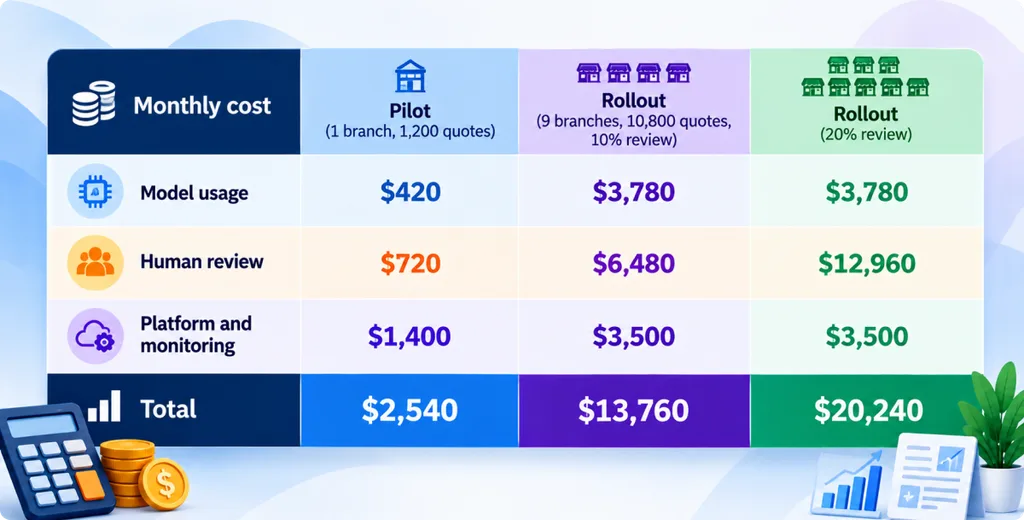
Cost per quote falls from $2.12 to $1.27, which looks like progress. Yet the monthly bill grows from $2,540 to $13,760, more than five times over. If the review rate doubles to 20%, it reaches $20,240, about 47% higher. A sensible AI adoption strategy would model that doubling before approval. And the model hasn’t changed at all. Only the number of quotes needing a person has.
Review Is the Line That Moves
At a 10% review rate, review makes up almost half of the rollout bill. At 20%, it’s nearly two-thirds. Review time per quote can climb too, since custom parts take longer to check than catalog items. Vendor quotes often leave that line out, since they price the model and the platform. And who pays for the reviewers? They sit on the distributor’s own payroll. Any plan that ignores them will look cheaper than it is.
Buy or Build Changes the Bill
A reviewer from an AI strategy services firm would start with one number from the MIT report. Tools bought from specialist vendors succeeded about two-thirds of the time. Internal builds succeeded about a third as often. One reading is that internal teams underestimate the work around a model, such as integration, monitoring, and review queues.
Gartner adds a caution on the buying side. It describes “agent washing”, where vendors relabel chatbots and robotic process automation as agentic. It estimates that only about 130 of the thousands of agentic vendors are genuine.
Ownership, Tests, and the Roadmap Document
By month four, the distributor had a working tool and a rollout bill. It still didn’t have an owner.
One Name per Row
Its first roadmap had phases and dates but no names. Version two, an enterprise AI roadmap, uses one row per use case instead. Each row carries five fields.
- A named owner from the business side
- Baseline measured before launch, such as 3.0 days per quote
- A monthly cost ceiling
- A stop signal written in advance
- A date for the next review
Finance can read rows quickly, and gaps in ownership show up at once.
A Test Set the Model Never Sees
Early on, the buyers marked the correct answers for 250 past quotes. That set was locked. After every model update, or change in a supplier’s file format, the tool reran against it. Any drop in the score appeared within a day. Without the set, the first warning would’ve been a customer complaining about a wrong price. So an AI implementation roadmap can list the frozen set as a line item, along with whoever maintains it.
Monthly Reviews in Year One
Monthly reviews sound excessive. Early on, though, assumptions are least tested, and the cheapest corrections happen then. Each review fits on one page and carries three figures.
- Cost per quote
- Test-set score
- Current stop-signal reading
If a figure is missing, that’s the finding. An outside reviewer sat in on the first six to keep the page honest.
How the Distributor’s Story Ended
This story ended well, though the distributor is invented. A short round of AI strategy consulting could have reached the same point in a few weeks.
In the invented ending, the lookup tool cut quote time from 3.0 days to about 2.2. Discount pre-approval followed in month seven. As for the drafting assistant, it arrived last and saved the least. Customers never asked for a drafting tool. They asked for a faster answer. Nobody minded. Earlier steps had already moved the number customers cared about.
Real programs don’t run that smoothly. Still, the order of work seems to travel well. Teams measure the delay first, then rank the candidates. After that come the rollout price and an owner. Companies with thin analytics benches sometimes add AI business consulting just for the early measurement.
For a live project, where does the time or money actually go today? If nobody can answer, the roadmap is still a wish list. Even a rough number beats a guess. That alone can change the order of work.
Book a working session to map where your delay actually sits.